
8
Every traveler, business professional, and solo wanderer eventually faces the same scenario. You step out of a restaurant, train terminal, or conference center, and the daylight that guided you earlier is gone. The city streets that felt vibrant and welcoming six hours ago have emptied out, storefront shutters are pulled down, and your hotel is a twenty-minute walk away.
Navigating an unfamiliar urban center at night brings a specific kind of mental friction. In your home city, you operate on intuitive muscle memory. You know instinctively which blocks stay lively after midnight, which corners host late-night trouble, and where the lighting abruptly cuts off. In a city you do not know, that mental map does not exist. You are forced to interpret subtle environmental cues in real time while processing transit signs, irregular street layouts, and unfamiliar social dynamics.
Staying safe in these moments is not about harboring fear or assuming catastrophe lurks behind every corner. It is about reducing environmental vulnerability, eliminating obvious signs of disorientation, and keeping enough mental bandwidth free to make smart, calm decisions.
Environmental Calibration Before You Step Outside
The most effective safety measures happen while you are still inside a well-lit, controlled environment. Walking out of a venue and immediately pausing on the sidewalk to orient yourself signals to anyone watching that you are disconnected from your surroundings.
Before you leave a venue, take sixty seconds to study the terrain between your current position and your destination. Look beyond the total walking time displayed on your navigation app. Zoom in on the suggested route to inspect the street types. A route that cuts through an unlit municipal park, weaves behind a train depot, or traverses an empty warehouse district might shave five minutes off your trip, but it drastically increases your exposure to isolated environments. Choose routes that follow major commercial corridors, transit lines, or avenues lined with active night-shift businesses such as hotels, diners, and convenience stores.
Setting Up Invisible Digital Navigation
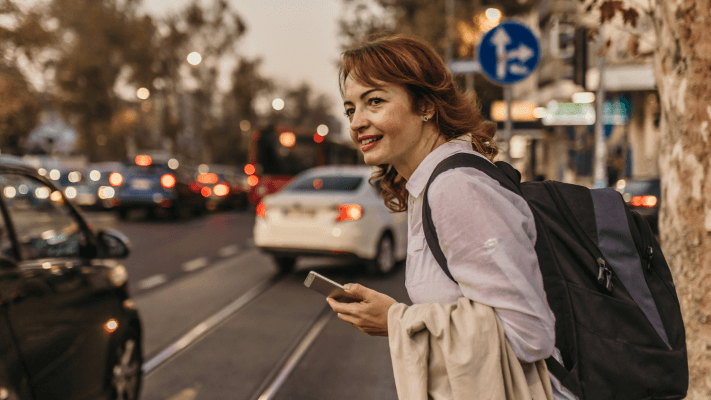
Staring down at a brightly illuminated smartphone screen is one of the most common mistakes solo walkers make. A lit screen acts as a beacon, destroys your natural night vision, and pulls your focus completely away from your immediate perimeter.
Set up your technology to guide you discreetly before stepping through the doors:
-
Enable audio or haptic turn-by-turn prompts: Connect a single low-profile earbud or use the vibration pulses on a smartwatch to track turns so your phone can stay safely out of sight in your pocket.
-
Download offline maps: Network dead zones frequently cluster in underground pedestrian passages, dense concrete canyons, and outlying city quarters. Having cached map data guarantees you will not lose guidance if your connection drops.
-
Preserve critical battery life: Never leave a venue late at night with your phone battery hovering below fifteen percent. If your battery is low, take twenty minutes to purchase a drink and use a wall outlet, or carry a compact magnetic battery pack.
-
Share an active location link: Send a temporary live-tracking link to a trusted friend, colleague, or family member who is awake, letting them know your intended arrival time.
The Physical Mechanics of Urban Presence
Predatory crime in metropolitan areas is rarely random; it is opportunistic. Research across urban sociology and criminology consistently demonstrates that individuals targeting pedestrians look for distinct visual indicators: slowness of pace, signs of physical hesitation, erratic directional changes, and obvious cognitive distraction.
When you walk alone at night, your physical carriage communicates your level of vulnerability before you ever exchange words with anyone.
Walking with Purpose and Pace
Walk roughly ten to fifteen percent faster than your casual daylight pace. Keep your chin parallel to the ground, your shoulders relaxed, and your arms swinging naturally rather than stuffed deeply into your pockets. Having your hands free improves your balance and ensures you can react instantly if you trip or need to create physical space.
Even if you are completely unsure whether your next turn is on 4th Street or 5th Street, walk toward that intersection with the certainty of a local heading home from work. Indecision invites unwanted engagement. If you realize you are heading in the wrong direction, do not freeze, spin around abruptly, or look up at the street signs with visible frustration. Instead, maintain your cadence, cross the street at the next crosswalk, or turn the corner smoothly as if executing an intentional detour.
The Protocol for Re-Orienting
If you become genuinely lost, never pull out your phone and wander aimlessly while squinting at a blue pulsing dot on a map. Standing still in the middle of a dim sidewalk while rotating your phone in circles marks you immediately as disoriented and vulnerable.
When you need to verify your position, locate an active, illuminated anchor point. Step inside an open convenience store, walk into the lobby of a high-end hotel, or stand directly beneath a municipal streetlight outside an open restaurant. Take your phone out, confirm your path, memorize the next three turns, put the device completely away, and resume your walk.
Sensory Management and Space Creation
At night, your senses work as an early-warning radar system. Diminishing those senses or surrendering your physical buffer zones leaves you with zero reaction time if a threat materializes.
The Rules of Situational Hearing
Wearing noise-canceling headphones or walking with both earbuds playing music is an unacceptable risk when traveling solo through unfamiliar streets after dark. Ambient auditory cues provide your first warning of changes in the environment: the sound of approaching footsteps behind you, a bicycle rolling along the sidewalk, an idling car matching your speed, or raised voices around an upcoming corner.
If you rely on audio navigation prompts, leave one ear completely uncovered. Keep the volume low enough that you can clearly hear the rustle of leaves, traffic sounds, and conversations around you. If you are in an area that feels deserted or unpredictable, remove personal audio devices entirely.
Geometry and Sidewalk Positioning
Where you place your body on the sidewalk significantly impacts your reaction time.
Avoid hugging the inner edges of buildings, high fences, or storefront alcoves. Walking tight against structural facades exposes you to blind corners, recessed doorways, and hidden alleyways where someone can step directly into your path before you have time to adjust.
Position yourself toward the street side of the sidewalk, roughly two to three feet from the curb, provided traffic is moving at safe speeds. This buffer grants you clean sightlines around corners and prevents anyone from concealing themselves in shadowy entryways. When rounding a street corner, swing wide rather than cutting close to the wall. Giving yourself an extra five feet of visibility around a blind architectural corner allows you to spot gatherings, construction barriers, or suspicious activity early enough to cross the street without creating an awkward confrontation.
Handling Street Encounters and Unwanted Interactions
Late-night urban centers contain a wide variety of people, from harmless night-shift workers to aggressive panhandlers, intoxicated revelers, and street hustlers looking to exploit travelers. Knowing how to filter and manage these interactions prevents minor awkwardness from escalating into dangerous conflict.
The Firm, Continuous Boundary
When approached on the street by someone asking for money, the time, directions, or a cigarette, your primary objective is to maintain physical momentum. Slowing down to listen or stopping out of polite social conditioning hands spatial control of the interaction over to the other person.
Do not stop walking. Do not break your stride. Turn your head slightly toward the individual, make brief eye contact, keep your hands visible, and deliver a neutral, definitive verbal response in a calm, flat tone:
-
“I can’t help you tonight.”
-
“No, sorry.”
-
“Keep moving.”
Avoid overly apologetic language such as prolonged excuses or nervous laughter, which can project weakness or encourage the individual to persist. A firm, polite refusal delivered while you continue walking establishes a clear boundary without presenting an overt challenge or insult that might provoke an aggressive ego response.
Dealing with Sustained Attention
If you suspect someone is following you or deliberately matching your pace, do not dismiss your intuition as irrational paranoia. Validate the suspicion quickly through intentional behavioral checks.
Cross the street at the next intersection. If the individual crosses as well, execute two consecutive right or left turns. If they mirror these unnatural maneuvers, you are no longer dealing with a coincidence.
Once your suspicion is confirmed, drop all concerns about appearing polite:
-
Change your pace immediately: Pick up your speed toward the nearest populated area.
-
Make it clear you know they are there: Turn around fully, look directly at them, and take a deliberate step toward an open, populated space. Many opportunistic predators rely on surprise and disengage once they realize their target is fully alert.
-
Head for an active business: Never walk directly back to a secluded vacation rental, an unstaffed apartment building, or an empty side-street hotel if you suspect you are being followed. Enter the nearest open commercial establishment immediately.
Strategic Safe Havens and Using the Abort Button
Every city has functional safe havens scattered throughout its core, provided you know what to look for.
Luxury and business hotels are among the most reliable urban refuges in the world. Their ground-floor lobbies are almost universally staffed twenty-four hours a day, well-lit, covered by security cameras, and open to the public. If you feel uncomfortable, step straight into a hotel lobby, walk past the reception desk, and sit down in the lounge area. Hotel staff will rarely question someone sitting quietly in a lobby, and the presence of front-desk personnel and security creates an immediate deterrent. From that secure position, you can regain your composure, consult your map, or arrange reliable transit.
Twenty-four-hour pharmacies, gas stations with open retail stores, active fire stations, and diners serve a similar protective purpose.
The Economics of the Abort Option
One of the most persistent errors solo travelers make is allowing financial frugality to override personal safety. Walking late at night to save twenty dollars on a rideshare, cab, or public transit fare is a terrible trade-off when weighed against the potential cost of an altercation, a robbery, or the stress of navigating a threatening environment.
Recognize when the walk should simply be abandoned:
-
The street lighting ends abruptly, leaving an unlit corridor ahead.
-
You encounter large groups blocking the path with nowhere to cross cleanly.
-
You feel a persistent, visceral sense of unease that causes you to second-guess every block.
-
Physical fatigue or minor alcohol consumption has dulled your reaction times and spatial awareness.
When these conditions appear, call a rideshare or hail an official city taxi. Wait inside a lit, populated doorway until the vehicle arrives, verify the license plate and driver identity against your booking application before opening the door, and complete the remainder of your journey safely inside a vehicle.
Cultivating Autonomy and Confidence
Walking alone through a new city at night does not have to be an ordeal defined by anxiety. Cities possess an entirely distinct character after hours—architectural details stand out against quiet streets, iconic landmarks clear of daylight crowds, and the ambient noise of daily commerce fades.
Safety is not about restricting your freedom or locking yourself inside a hotel room the moment twilight arrives. It is about practicing disciplined spatial habits, maintaining active awareness of your perimeter, and moving through the world with deliberate intention. When you master the mechanics of urban navigation, you reclaim your autonomy, allowing you to experience the world on your own terms with absolute confidence.
