
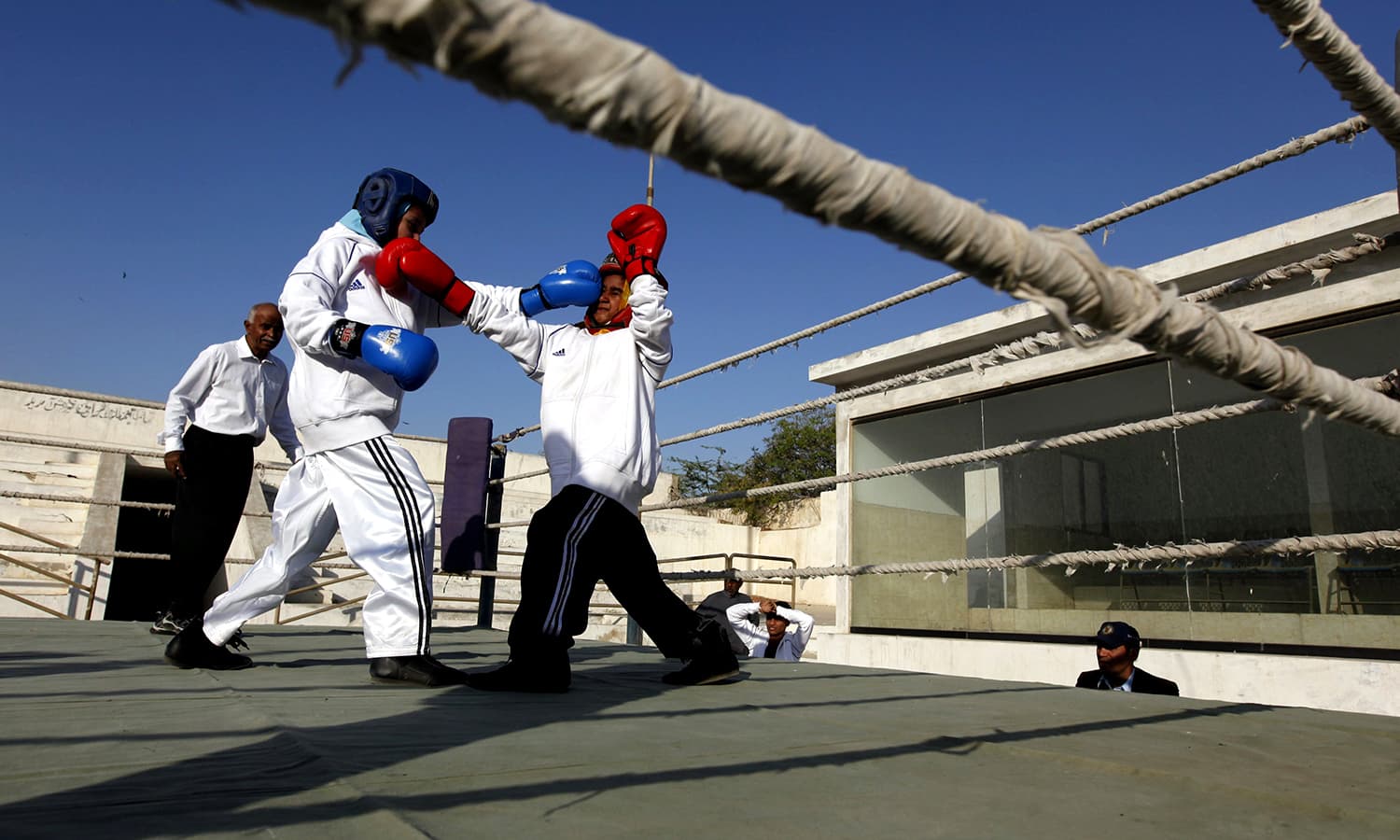
The Ali Mohammad Qambrani Boxing Stadium stands in Lyari, named for a man who helped build Pakistani boxing before the country itself was a year old. The stadium’s existence is a measure of institutional recognition, but understanding what the Qambrani family actually contributed requires looking beyond any stadium dedication and beyond any single generation’s competition record.
Ali Mohammad Qambrani was among the earliest organizers of boxing in Pakistan, a founding figure of the Muslim Azad Boxing Club in Lyari who began attracting young men from the neighborhood to train in the sport in the years surrounding partition. The club’s founding predates Pakistan’s independence; its continuation into the new country gave Lyari an institutional anchor for boxing that neighborhoods elsewhere in Karachi and across Pakistan rarely had. One of the first Pakistani Olympic boxers, Muhammad Khan — a Pashtun who had settled in Lyari — trained under Ali Mohammad Qambrani before competing at the 1952 Helsinki Olympics.
That origin point matters because it establishes something the Qambrani family has maintained across generations: the family’s contribution to Pakistani boxing has never been purely athletic. From the outset, it combined competitive performance with club administration, coaching, and the structural work of keeping boxing organized and accessible in a community where none of that was guaranteed.
Three Generations, One Neighborhood
The family tree of Qambrani boxing is sufficiently extensive to require navigation. Ali Mohammad Qambrani’s sons included Siddique Qambrani, who competed at the 1970 Asian Games in Bangkok and became well known in Pakistani boxing circles for defeating an Israeli opponent at those Games. Siddique’s son, Ali Mohammad Qambrani, who shares his grandfather’s name, became the family’s most decorated competitive athlete. He began boxing at age 12, won his first national title at age 13 in an interprovincial under-14 championship, and spent the decade from 1990 to 1999 on the Pakistan national squad. His record included a junior silver medal at the 1994 Asian Games in Hiroshima and gold at the 1995 Asian Boxing Championships in Manila. He was the five-time national champion from 1995 to 1999. He died in October 2009 at Lyari General Hospital, aged 40, after complaining of head pain — a loss that the boxing community in Lyari absorbed alongside the gang violence that was simultaneously devastating the neighborhood.
The family extended further. Mohammad Hashim Qambrani, who died in 2007 at age 95, had seven sons, all of whom boxed. Among them were Olympian Abdul Rasheed Qambrani — who represented Pakistan at the 1996 Atlanta Olympics in the light flyweight division — and Younus Qambrani, who became a coach. Maherullah Lassi Qambrani won gold at the 2002 Asian Games in the featherweight division and then competed at the 2004 Athens Olympics, where he lost to Cuba’s Guillermo Rigondeaux, a two-time Olympic champion regarded as one of the finest amateur boxers of his era.
The range here — from 1948 Olympic preparation to 2004 Athens competition — spans more than half a century of continuous family presence in Pakistani boxing.
Younus Qambrani and the Coaching Line
The family’s most consequential living figure in boxing may be Younus Qambrani, who has been coaching in Lyari since 1994. He founded Pak Shaheen Boxing Club and has operated it continuously despite conditions—the gang wars of 2008-2013, the COVID-19 lockdown, and chronic underfunding—that would have closed most institutions.
What distinguished Younus’s tenure at Pak Shaheen was a decision he made in 2013: he began training girls. The reaction from within the boxing community was dismissive. Peers told him girls were too delicate for the sport and that no one would sign up. He proceeded regardless, and Pak Shaheen became one of the first boxing clubs in Pakistan to offer a women’s training program. “I was sitting with some of my friends from the boxing fraternity, and I asked why we weren’t training our girls,” he said, explaining his reasoning. The answer he got — that it was impossible — did not satisfy him.
His daughter, Anum, trained at Pak Shaheen and began coaching girls herself, thereby creating a second generation of female boxing instruction within the same family. Razia Abdul Aziz, who contacted Younus in 2016 after finding his club online, became one of Pak Shaheen’s notable pupils; she later won Pakistan’s first amateur national gold medal in women’s flyweight boxing, a milestone that traced directly back to Younus’s decision three years earlier to open the gym to women. Younus trained all his female athletes free of charge, operating on the principle that access to coaching should not be limited by finances in a neighborhood where finances were perennially constrained.
The women’s program also attracted students from beyond the family’s own circle. Azmeena, a Kutchi-community girl whose father and uncle had trained with Younus in the 1990s, joined after seeing a video of Anum and the other girls boxing. Anisa Mohammad Asghar, who woke at dawn to complete household responsibilities before reaching the club each afternoon, trained alongside her with the same Olympic aspirations. These were not marginal additions to Pakistani boxing—they were its frontline in a sport where women’s participation had been largely invisible.
Institutional Memory and Its Limits
Sport360 captured Younus’s view of the period following Anwar Chowdhry’s death in 2010 directly: since the demise of Pakistani boxing’s most powerful international administrator, the sport had lost its main benefactor, and the authorities had not provided adequate support to young boxers. This assessment — from a man who had watched Pakistani boxing from inside its most productive neighborhood for four decades — carries weight precisely because it comes with comparative context. Younus had seen what organized support looked like while Chowdhry was in operation. He knew what its absence meant.
The Qambrani family’s history in Pakistani boxing is therefore also a record of what voluntary, community-sustained sporting institutions can and cannot do without external support. They can produce Olympians. They can run free coaching programs for girls in one of Karachi’s most economically stressed neighborhoods. They can maintain club operations through gang wars and pandemics. What they cannot do is substitute for a national development system that funds athlete preparation, builds training infrastructure, and creates competitive pipelines. The family has done more than almost anyone to keep Pakistani boxing alive in Lyari for almost seventy-five years. The sport’s inability to build durable institutions around that foundation is not a Qambrani failure.
The stadium named after Ali Mohammad Qambrani stands in the neighborhood where the family first began training fighters. His grandsons competed at the Olympics. His great-grandsons have taken up boxing. When Younus Qambrani opened Pak Shaheen to girls and then trained them without charge, he was doing what the family has always done — extending boxing’s reach in Lyari to whoever showed up wanting to learn. That continuity is the Qambrani legacy, and it is considerably larger than any medal count.
